When the Pocket Left the Seam
Pocket history traces how a separate pouch gave way to pockets built into garments, helping you read how construction and silhouette changed together.
The common mistake in reading pocket history is to treat a seam opening as proof that a garment contains its own pocket; that can hide the difference between a wearable pouch and built-in storage. The pocket’s move from separate accessory to garment feature was gradual, and its chronology varied by clothing type and wearer.
Separate pouches came before many built-in pockets
In Europe, from the late medieval period into the early modern era, people commonly carried small pouches tied at the waist beneath outer garments. These detachable pockets belonged to the wearer, not to a particular skirt or coat, and could be reached through slits in the clothing.
The arrangement depended on both pieces working together: the pouch held objects, while an opening in the outer layer provided access. A slit at a side seam might therefore lead to a separate pouch rather than to a bag sewn into the garment.
That distinction matters when examining an old garment or a reproduction. Look behind the opening for a cloth bag attached to the garment; if there is no bag, the slit may have served as access to a separate pocket worn underneath.
Garment pockets developed unevenly from the seventeenth century
By the seventeenth century, pockets sewn into garments were becoming more common in parts of Europe, though separate tie-on pockets remained in use, especially in women’s dress. The change was not a single switch: construction and access differed across regions, social settings and garment types.
During the eighteenth century, women’s gowns and petticoats could still accommodate detachable pockets reached through openings in the outer skirt. Men’s coats and waistcoats, meanwhile, commonly incorporated pockets as part of their construction. A seam opening alone does not date a garment; the surrounding cut, fabric and construction need to be considered together.
As women’s fashions changed around the turn of the nineteenth century, slimmer dress shapes left less room for large pouches worn beneath skirts. Built-in pockets and small bags carried separately both remained options, depending on the garment and its use. There was no universal moment when the tie-on pocket disappeared.
Seam pockets kept storage discreet
As pockets became attached to garments, they often remained concealed in seams or beneath folds. This preserved a smooth outer surface and kept stored items close to the body, though a pocket bag still needed room and support inside the garment.
Side-seam pockets illustrate the trade-off. They can be easy to reach while blending into a skirt, dress or trouser leg, but their shape depends on the surrounding cloth. A heavy object may pull the seam down or make the pocket bag show through lighter fabric.
Tailoring can secure a pocket bag to a waistband or lining so it does not swing freely, while the opening stays discreet. When inspecting a garment, feel gently around the seam for the bag’s edge; its attachment can reveal how the maker balanced access with a clean line.
Visible pockets made storage part of the silhouette
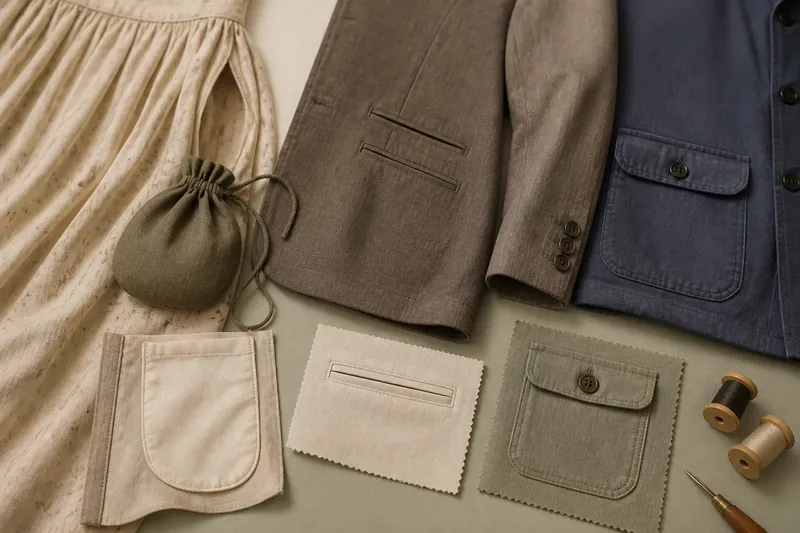
A patch pocket is a piece of cloth sewn onto the garment rather than hidden inside it. Its outline adds a visible boundary and texture; scale and placement can make a jacket feel workmanlike, informal or carefully ordered.
Flaps, buttons and shaped corners also guide the eye. A flap may cover an opening, while a button or decorative stitch draws attention to the pocket’s position. Matching pockets can anchor a garment’s front; a single pocket can create deliberate asymmetry.
Visible storage is not necessarily more useful storage. An open top gives easy access but leaves contents exposed, while a flap offers more cover and may add bulk. The design makes the balance between access and appearance easy to see.
Workwear and tailoring used different pocket finishes
Work jackets, aprons and utility trousers often place pockets where a wearer can reach tools or everyday objects without opening another layer. Sturdy cloth and reinforced openings make storage conspicuous, presenting the pocket as a feature intended for use.
A welt pocket, by contrast, has a narrow slit finished with one or two strips of fabric. It can sit neatly within a jacket or trouser front, keeping the exterior restrained, although the pocket bag still needs room inside. Bulky contents can disturb the line.
These are not rigid categories. A work-inspired jacket may borrow a tailored welt, and a formal-looking coat may have a generous patch pocket. Read the position, finish and relationship to the garment’s other lines rather than relying on its label alone.
Pocket placement answers practical questions
Why do some pockets sit inside a seam?
A seam pocket hides its opening within a line that already joins two pieces of cloth, keeping the outer surface quiet. Its usefulness depends on an opening that is easy to locate and a pocket bag supported well enough not to distort the seam.
Why are some pockets sewn shut?
A garment may arrive with an opening lightly secured to preserve its shape during display or handling. Check whether the stitching is loose and temporary before removing it; if the construction is unclear, ask a tailor to identify the finish without damaging the cloth.
How can you tell whether a pocket is functional?
Look for an opening that leads to a cloth bag rather than ending at lining or another layer of fabric. Some decorative flaps cover no pocket, while a real pocket may be stitched closed for presentation.
Why do pockets sometimes pull a garment out of shape?
The pocket bag and its contents add weight to a small area, and the cloth around the opening may not be designed to carry much. A sagging edge or diagonal drag line can signal overloading or insufficient support.
A close inspection reveals what the pocket was made to do
Start with the opening: does it sit in a seam, form a slit in a panel or belong to a patch sewn on top? Then notice the flap, button, lining and reinforcement. Together, these details distinguish a pocket designed for quick access from one intended to preserve a smooth front.
Say you are comparing two invented jackets made from similar cloth. One has discreet welt pockets; the other has broad patch pockets with visible stitching. The welted jacket’s front looks more restrained, while the patch pockets make the second look more practical and prominent; neither appearance alone tells you which holds more.
For a useful inspection, check each feature and let the observation guide your next decision:
- Opening: If it lies in a seam, look behind that seam for a bag; if the slit has no attached bag, consider whether it once gave access to a separate pouch.
- Bag: If a cloth pouch is attached to the garment, treat it as built-in storage; if no pouch is present, do not assume the opening is a complete pocket.
- Support: If the bag connects to a waistband, lining or reinforced area, note that the construction supports the pocket; if it hangs freely, expect the contents to move more.
- Finish: If a flap or button opens onto a bag, read it as both a functional finish and a visual detail; if it covers solid cloth, treat it as decorative.
- Position: If pockets balance the front symmetrically, read them as part of its visual structure; if one sits alone, consider whether it creates an intentional accent.
- Stitching: If stitches at the opening are loose and temporary, check carefully before removing them; if they appear integral or the fabric is delicate, leave them in place and ask a tailor.
Pocket history is best read as a sequence of overlapping choices, not a clean transfer from one kind of clothing to another. The useful clue is often behind the visible opening: a separate pouch, an attached bag or no storage at all can explain why the garment’s seam looks the way it does.