Inside the Shirt Placket: Layers, Overlaps and a Neat Front
Learn how a shirt placket’s layers, overlap and button placement keep the front tidy, and how to choose between common placket constructions.
A common mistake when comparing shirt plackets is to judge only the visible strip of fabric; the result can be a shirt that looks tidy on a hanger but pulls, gaps or feels awkward when fastened. The shirt placket is the constructed opening at the front, and its layers and fastening positions determine how that opening behaves as well as how it looks.
Different placket constructions solve the same practical problem in distinct ways: they reinforce an opening, give buttons or other fasteners a secure place, and bring the two front edges together. Knowing what sits behind the visible stitching makes it easier to understand why one shirt has a crisp, prominent front while another appears almost seamless.
The shirt placket controls how the front opens and closes
A shirt front is usually made from two pieces that meet along the centre line. A placket is the finished section at that meeting point: fabric is folded, added or otherwise reinforced so one edge can overlap the other and hold a fastening.
On a button-front shirt, the button side and the buttonhole side do different jobs. Buttons are sewn to one layer, while buttonholes are worked into the opposing layer; when closed, the layers overlap and conceal the opening. The direction of that overlap can vary by garment design, so it is more useful to inspect how the pieces lie than to assume there is one universal arrangement.
The overlap also helps the front remain visually continuous. Without a finished, reinforced opening, the raw edges would need another treatment, and the fastening would have less stable fabric to support it. Placket width, stitching and button spacing all contribute to the impression of order, but none works in isolation from the shirt’s fabric and fit.
A separate front placket gives the opening a defined strip
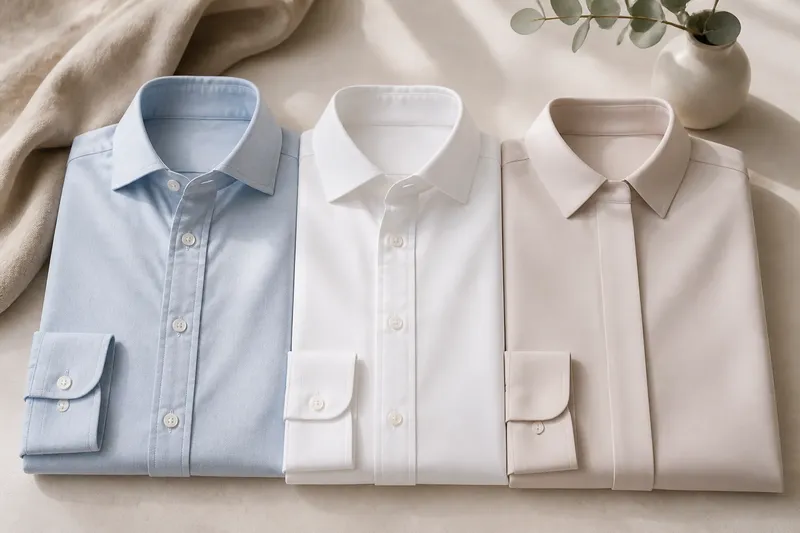
In a separate or applied front placket, a narrow strip of fabric is attached to the shirt front and folded or finished to create the fastening area. The added layer gives the buttons and buttonholes a visibly structured zone. On many shirts, this construction appears as a raised or outlined band down the centre front.
This option suits designs where the placket is meant to be part of the visual language: a crisp everyday shirt, a more formal shirt or a garment with contrasting stitching or buttons. The extra fabric can make the centre line look deliberate and substantial, while the strip provides a clear place for the fasteners to sit.
That definition has a trade-off. A separate strip adds a visible seam and another layer, which may feel more pronounced on a light, fluid fabric than on a cloth with enough body to support it. Look at the placket from the side as well as straight on: a smooth transition into the shirt front suggests the added strip has been integrated neatly, while puckering or a stiff ridge may distract from the design.
A folded front placket keeps the construction within the shirt front
A folded or self-fabric placket is formed by turning part of the shirt front back on itself, rather than attaching a separate strip. The resulting folds create the layers needed for buttons and buttonholes while keeping the placket visually connected to the front panel.
This approach often suits shirts intended to look clean and uncomplicated. Because the placket can read as a continuation of the body fabric, it may be less conspicuous than an applied strip. It is not necessarily thinner or softer, however: folded layers still create thickness, and the effect depends on the cloth, the width of the fold and the finishing.
Imagine choosing between two cotton shirts for a work wardrobe. One has a distinct applied band that gives the centre front a crisp line; the other uses a folded placket that blends into the body. If you want the fastening to frame the shirt visibly, the first may suit you; if you prefer a quieter front, the second may be the better match. In either case, fasten the top and middle buttons and check that the overlap lies flat rather than twisting.
A concealed placket hides most of the fastening
A concealed placket places a layer of fabric over the buttons, so the closed shirt presents a relatively uninterrupted front. The buttonholes and buttons remain part of the construction, but a fold or facing hides them from view. Some designs conceal the fasteners almost entirely; others leave a small part visible at the collar or hem.
This suits a shirt whose design depends on a smooth centre line, such as a dressier shirt worn under a jacket or a minimalist blouse. It can also make the fabric itself more prominent by removing the row of buttons as a competing detail. The result depends on how securely the covering layer sits: if it flips open or bunches, the hidden construction becomes noticeable in a different way.
Concealment is not the same as having no placket. The fabric still has to open, overlap and carry the fastening, so the internal layers matter even when they are difficult to see. Inspect the front with the garment closed and slightly open: the covering should lie neatly, and the opening should remain accessible without forcing the fabric aside.
Button placement keeps the overlap aligned
Buttons are positioned to meet their corresponding buttonholes along the overlap. If they sit too close to an edge, the fabric may roll or the fastener may feel exposed; if the spacing or alignment is inconsistent, the front can appear uneven when closed. The placket’s width gives the fastening room, but the placement must also suit the shirt’s cut and intended use.
Look for a straight centre line when the shirt is laid flat, then check how the buttonholes sit relative to the buttons when the garment is fastened. A slight wave may come from the cloth or the way the shirt is resting, so assess the whole front rather than treating one wrinkle as proof of poor construction. Persistent pulling across the chest or abdomen can also indicate that the shirt is too small or shaped differently from your body, not simply that the placket is faulty.
Button spacing affects both appearance and access. A shirt worn open at the collar may have a different visual rhythm from one intended to close high at the neck, while a concealed placket needs enough room for the hidden buttons to fasten without distorting its cover. Check the areas that matter for your use: the collar, chest and lower front may each behave differently.
Which shirt placket suits your priorities?
What is the difference between an applied and a folded placket?
An applied placket uses a separate fabric strip attached to the shirt front, while a folded placket turns part of the shirt front to form the fastening area. The applied version usually reads as a more distinct band; the folded version can look more integrated with the body fabric.
Does a concealed placket make a shirt more formal?
It can create a restrained, uninterrupted front that suits some dressier designs, but formality also depends on the cloth, collar, fit and finish. A concealed placket on a very casual shirt will not by itself make the whole garment formal.
How can I tell whether a placket is lying flat?
Fasten the shirt and look at the centre front from collar to hem, then turn slightly to see whether the overlap lifts or twists. A tidy placket should close without persistent ripples or visible strain, although fabric creases and fit can affect what you see.
Which placket should I choose for a simple everyday shirt?
Choose by the effect you prefer and how the shirt feels when worn: an applied band for a clearly defined centre, a folded placket for a quieter finish, or a concealed version for a front with hidden buttons. Compare the construction on the actual garment, since fabric and finishing can make two plackets of the same type look and feel different.
Choose by the visible effect and the way the shirt sits
When shopping, start with the front you want to see. A separate strip draws attention to the fastening, a folded construction keeps the placket closer in appearance to the shirt body, and a concealed design puts the emphasis elsewhere. Then fasten the garment and check whether the layers lie comfortably against your body.
Also consider how the shirt will be worn. A placket that looks polished beneath a jacket may be less important when the shirt is usually worn open, while a visibly structured band may suit a shirt worn on its own. Where construction details or care requirements depend on the fabric or maker’s instructions, check the garment label and the manufacturer’s guidance.
The shirt placket is a small part of the garment, but it is where fabric, fastening and appearance meet. Once you can recognise its layers and overlap, you can choose a shirt not just for its front view, but for the way that front opens, closes and stays composed in wear.